Standing water
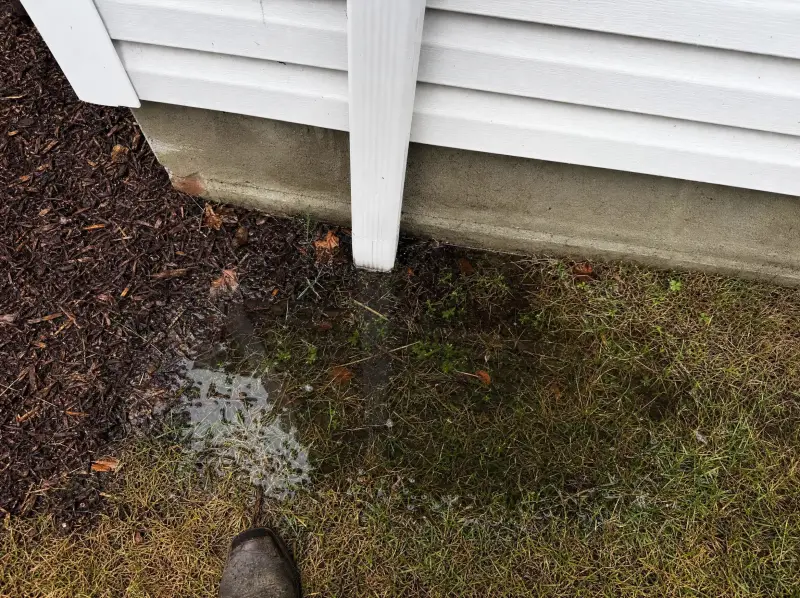
The same corner is wet days after the rain stopped. The lawn is soft, the mulch floats, and a downspout is emptying against the foundation.

Standing water, runoff from the neighbour’s lot, downspouts dumping against the foundation, a slope that never dries. We find what is actually causing it, and where the water is lawfully allowed to go, before we design anything.
Based in Mooresville. Free on-site walk-through, written price before any work.

An Eco IGS project: paver terrace at the water’s edge, Lake Norman. Our own work, not a stock photo.
It is rarely mysterious and it is rarely the whole yard. Before proposing anything we walk the property to find which of these is driving it, because the fix for one is the wrong fix for another.
Downspouts discharging at the foundation instead of away from it. Runoff arriving from a neighbouring lot. Added impervious surface sending more volume to the same place than the original grade was built for.
 Illustration
Grade that falls toward the house rather than away. Low spots that collect and hold. Soil compacted during construction. A drainage path that has been blocked, crushed, silted up or built over.
The Charlotte area averages 43.60 inches of rain a year and every month falls between 3.13 and 4.35 inches, so there is no dry season for a wet yard to recover in. The published soil profile for Mooresville (USDA Cecil series) is a sandy loam surface over red clay subsoil from roughly 8 to 42 inches. What that means for your lot is determined on site, not from a map.
The walk-through decides which one, or which combination, your lot needs. We do not sell a French drain to every yard.
One cross-section, five stages. Scroll through what happens between the first walk-through and the first storm afterwards.
Illustration for explanation only. Depths, routes and outlets are set per property.
The same corner is wet days after the rain stopped. The lawn is soft, the mulch floats, and a downspout is emptying against the foundation.
We walk the lot and check grade, downspouts, the neighbouring runoff and what is under the surface. The cause decides the fix, so this comes before any drawing.
The route is pitched to fall, and the outlet is confirmed first: your own property, a permitted right-of-way discharge, or a shoreline route with Duke Energy authorisation. Then you get a written price.
Trench, clean stone, fabric-wrapped perforated pipe and the downspout tie-in. Surfaces are put back and the lawn is restored over the run.
Roof and surface water leaves on its own. You get a walkthrough of where every outlet is and what to keep clear.
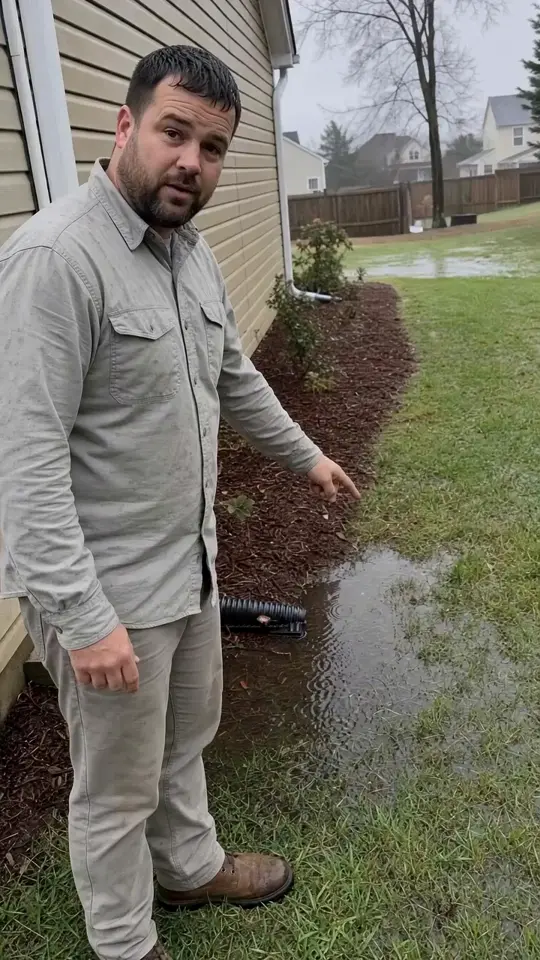
Three things decide most of what a drainage plan has to do, and all three are visible on a walk-through after rain.
Drainage runs disappear under the lawn, so here is the Eco IGS work you can see: walls, terraces and regrades on the same sloped, clay-heavy lots where the water problems start.


All photographs are Eco IGS projects. No stock and no generated images are presented as our work.
Someone from Eco IGS walks the property with you, in the wet corner if it is raining. We look before we talk.
Route, outlet, approvals if any, and a fixed written price. No phone quotes, no guessing.
Trenching, stone, pipe, basins or regrade as planned, then the lawn and beds put back.
We show you every outlet and cleanout, and what to keep clear so it keeps working.
We do not publish a price list for drainage because two yards with the same wet spot rarely need the same job. These are the things that change the number.
Answer a few quick questions. A local crew follows up to walk the property and tell you where the water is going.
Survey not loading? Call 704-980-7676 or email [email protected].
Mooresville and Iredell County both publish where their responsibility ends. Knowing those lines is half of designing a drainage outlet that will not be a problem later.
The Town of Mooresville states that “the repair and maintenance of all drainage systems located on private property shall be the responsibility of the property owner,” and publishes a list of what it does not maintain: yard flooding, standing water, water that flows from adjoining property, drainage problems caused by landscaping, and slopes. Iredell County puts it the same way: drainage problems are private property issues, and the County recommends hiring a qualified private consultant. There is no homeowner cost-share or drainage assistance programme in either jurisdiction; we checked, and the absence is the answer.
Clean groundwater has a classification: footing drains, foundation drains, crawl-space sump water and springs appear on the allowable non-stormwater discharge list under the municipal stormwater permit (NPDES MS4 permit NCS000540). That classification is not the same thing as permission to connect to a particular pipe, or approval of a particular discharge point, and it does not override an easement, a property line, a municipal requirement or an HOA covenant. We confirm the permitted disposal route for your specific project before we design the outlet.
NCDOT policy is explicit: drainage collected by ditches, gutters or pipes on private property shall not be discharged into the highway drainage system unless approved in advance by NCDOT. Where a drain wants to daylight toward the road, that approval is part of the job, not an afterthought.
Mooresville’s erosion control ordinance sets a 25-foot minimum construction buffer and, for lakes, measures it from “the most landward limit of the full-pond level.” Full pond on Lake Norman is 760.0 feet above mean sea level. That line does not move when the lake is drawn down, which is exactly why work planned against a low waterline in late summer can end up inside a buffer.
Lake Norman is inside Duke Energy’s project boundary, and the Shoreline Management Guidelines require prior written authorisation from Duke Energy Lake Services before shoreline stabilisation work. Duke also holds a deeded flood easement extending vertically above the full pond contour. If your drainage problem ends at the bank, that authorisation is the first step and we start it before designing.
Since 1 March 2026 the Town administers erosion and sedimentation control itself; Iredell County stopped accepting new projects inside the Town limits and ETJ on 6 February 2026. The Town’s plan threshold begins at half an acre of land disturbance rather than the state’s one acre. Most residential drainage retrofits sit well under that, but the office you file with changed, and contractors still working from the old county process get stalled.
Sources: Town of Mooresville, Erosion Control, Iredell County, Erosion Control, USDA, Cecil series, NOAA NCEI 1991–2020 normals, Charlotte Douglas.
Yes. Mooresville is our home base, and we work across town and the Lake Norman shoreline: the Brawley School Road peninsula and neighbourhoods such as The Point, The Farms, The Harbour, Commodore Peninsula and Bridgeport, plus the wider south Iredell area.
A perforated pipe set in clean stone below grade, wrapped so soil cannot clog it, pitched so the water it collects runs to somewhere it can safely and lawfully leave. The right depth, route and outlet are set by what we find on the property: where the water is coming from, where it is getting held, and what disposal point is actually available to you.
Often, yes. An interceptor drain inside your own property line is a common answer. The Town names “water that flows from adjoining property” on the list of things it does not maintain, so it is a private fix, and it has to work without pushing the problem across a boundary. Where the collected water can then be sent is a separate question we resolve before designing.
We do not quote drainage over the phone, and we would be guessing if we did. The number is set by the run length, the depth, where the water can legally go, and whether the outlet needs an approval. You get a written price after someone walks the property. The assessment is free.
Usually the disturbance on a residential drainage retrofit falls well under the Town’s half-acre erosion control plan threshold. Where a project touches the right-of-way, a lake buffer, or a road ditch, approvals do apply and we handle them. We check your specific address before quoting rather than assuming either way.
Yes. Eco IGS works out of Mooresville. Book a free on-site drainage assessment online or call 704-980-7676.
Book the free walk-through. If it is raining that week, even better: we would rather see the water than hear about it.